

AIM for my future: Student success story
What is a book that you read in high school that changed your life? For me, the answer is my Spanish textbook. This particular book introduced me to topics that would shape my future career and educational goals, and showed me how to access information in different ways. I found myself excited to do homework, reading my textbook on my own, and gaining a deeper understanding of topics that I had previously struggled with before. While I am yet to find a word in Spanish or any language that adequately describes the life-changing impact that accessible educational materials have had on my life, I know that none of this would have been possible without AIM-VA, the organization that provided this textbook (any many others) in a format that I could read, at no cost to my family or my school district. Without these accessible materials, I never would have graduated from high school, earned degrees in computational and data sciences or assistive technology, or started studying for a PhD.
I have low vision as the result of both an eye condition and a neurological condition, which affects my ability to read standard print— I mostly use things like large print, screen magnification, or other display customizations to access information visually. I had an IEP for visual impairment in high school, and it was impossible for me to read the small print and visual content in standard textbooks as a student with low vision. This led to my school district ordering digital textbooks from AIM-VA that I could enlarge on my computer or read independently even with a print disability.
Before these digital books were ordered, I had to rely on other people to read to me or I had to try and guess what was written on the page, which meant that I missed out on critical opportunities to practice reading skills, learn from textbook examples, and would struggle to do my homework. I had no idea which words had letters like ñ or ò because I couldn’t see the diacritical marks, and I consistently missed or ignored things like subscripts, superscripts, or exponents since I either didn’t notice they were there or found them hard to read even with a magnifying glass. I went from being a student on the honor roll to failing classes, or rather having classes fail me because I didn’t have access to things I could see. It was challenging to explain to my family, teachers, and friends why I had fallen so behind in my classes, and the profound impact that a lack of accessible materials had on my grades. I had no idea how I would pass my classes, and started wondering if I would have to drop out of high school, or if going to college would be pointless since I had so much trouble reading— as several people had pointed out, I would not be able to achieve any goals or ambitions that I had for myself if I couldn’t find a way to read or access visual information.
I still remember the excitement I felt when a member of my support team helped me download the accessible textbooks from AIM-VA shortly before the start of the new semester and my new classes. I was so excited to have textbooks that I could access on my own and that could be adapted for my fluctuating vision. Instead of only having information available in one font size, I could adjust the font size of the digital textbooks, zoom in on images or charts to make them even bigger, adjust my screen to make it easier to see, or listen to text read out loud using tools like text-to-speech so I didn’t have to strain my eyes to read every letter. I also had several options for reading apps and tools that make text easier to read, and could use devices like a computer or tablet for reading. After realizing how much of a difference that accessible textbooks and classroom materials made for me as a student, this sparked an interest in learning about the accessibility settings and assistive technology used by students with visual impairments to access materials for school.
Motivated by the experience of receiving textbooks that I could read, I decided that I would earn a degree in assistive technology and develop tools and strategies that help students with visual impairments thrive in the classroom setting. By learning how to use accessible materials in high school, I would be more prepared for life after high school as I could concentrate on learning, not on how much I had trouble seeing. Plus, having access to quality accessible educational materials meant that my grades improved dramatically, making it much easier for me to graduate from high school and attend my dream university!
One of the reasons why I love telling the story about how I received accessible educational materials from AIM-VA is because of how it has continued to have an impact on my life years after graduating from high school. As an undergraduate student at George Mason University, I had the opportunity to work with AIM-VA and develop resources for students with print disabilities, as well as learn about assistive technology and accessibility from the staff members who share their expertise on print disabilities through webinars, blog posts, and so much more. Even though AIM-VA only serves K-12 students, I learned a lot about what to consider when creating accessible materials and all of the different services that AIM-VA offers, like creating accessible worksheets, handouts, and even sheet music. Their online resources also helped me as I navigated the process of requesting and utilizing alternative formats in college. It is amazing to think about how I went from not having textbooks I could read to conducting research on textbook accessibility as part of my PhD many years later.
From IEP to PhD, accessible educational materials empower students with print disabilities to achieve more by giving them access to the same books and educational materials that their peers are using in a format that works for them. I still remember the joy from reading the same novel as my friends by enabling large print on an eReader, the satisfaction of correctly solving a math equation without wondering if I had misread the numbers when copying it from the textbook, and the confidence boost that came from knowing what accessible materials looked like for me, which also helped me feel more comfortable with self advocacy (a major component of my IEP goals). These experiences would help me connect with others and talk about my favorite books during an internship at a major tech company, as well as pass required calculus courses on my first attempt so I could graduate with a degree in computational and data sciences (with a minor in assistive technology) and help others pass their math and statistics classes too. Knowing that I could find information in accessible formats made it much easier for me to achieve my goals and ambitions with low vision, including things that I never would have imagined as a high school student like earning my M.Ed. in Assistive Technology or studying for a PhD.
Thanks to AIM-VA and accessible educational materials, I am not limited to only reading books or articles that are available in a certain font size, or tempted to exclude myself from situations or subjects where I am more likely to encounter content that I have trouble seeing because I don’t want my accessibility needs to be perceived as a burden— I have the opportunity to read more than I could have ever imagined, and I can fully participate in all of my classes when I have access to everything that my classmates are given by default. I am so grateful for the accessible high school Spanish textbook that enabled me to discover what I am passionate about, and that also taught me how to read text messages from my Spanish-speaking friends!
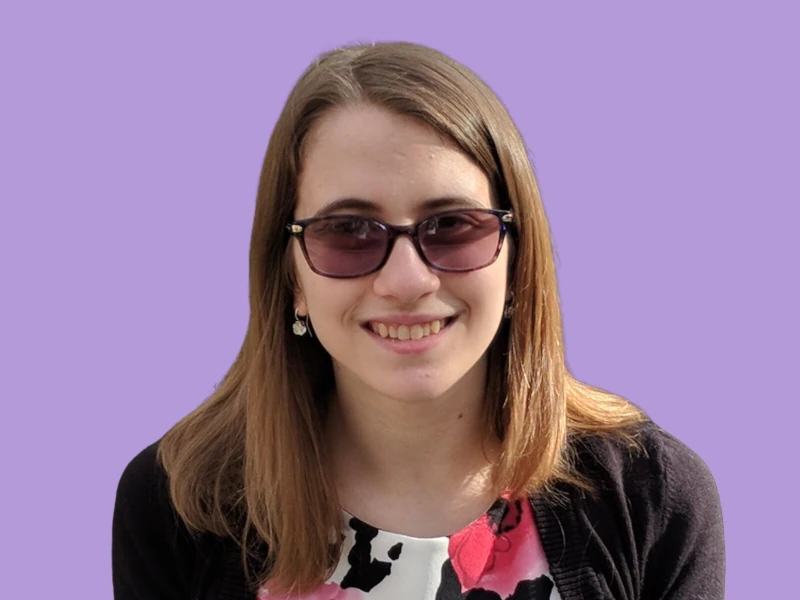
Veronica Lewis
Veronica Lewis is a PhD student at George Mason University that lives with low vision, learns with assistive technology, and writes all about it on her website Veronica With Four Eyes (veroniiiica.com). Her research focuses on supporting the use of assistive technology and compensatory skills for college and university students with visual impairments in physical and digital environments, and how accessibility can help students thrive.
 RSS Feed For AIM-VA Blog